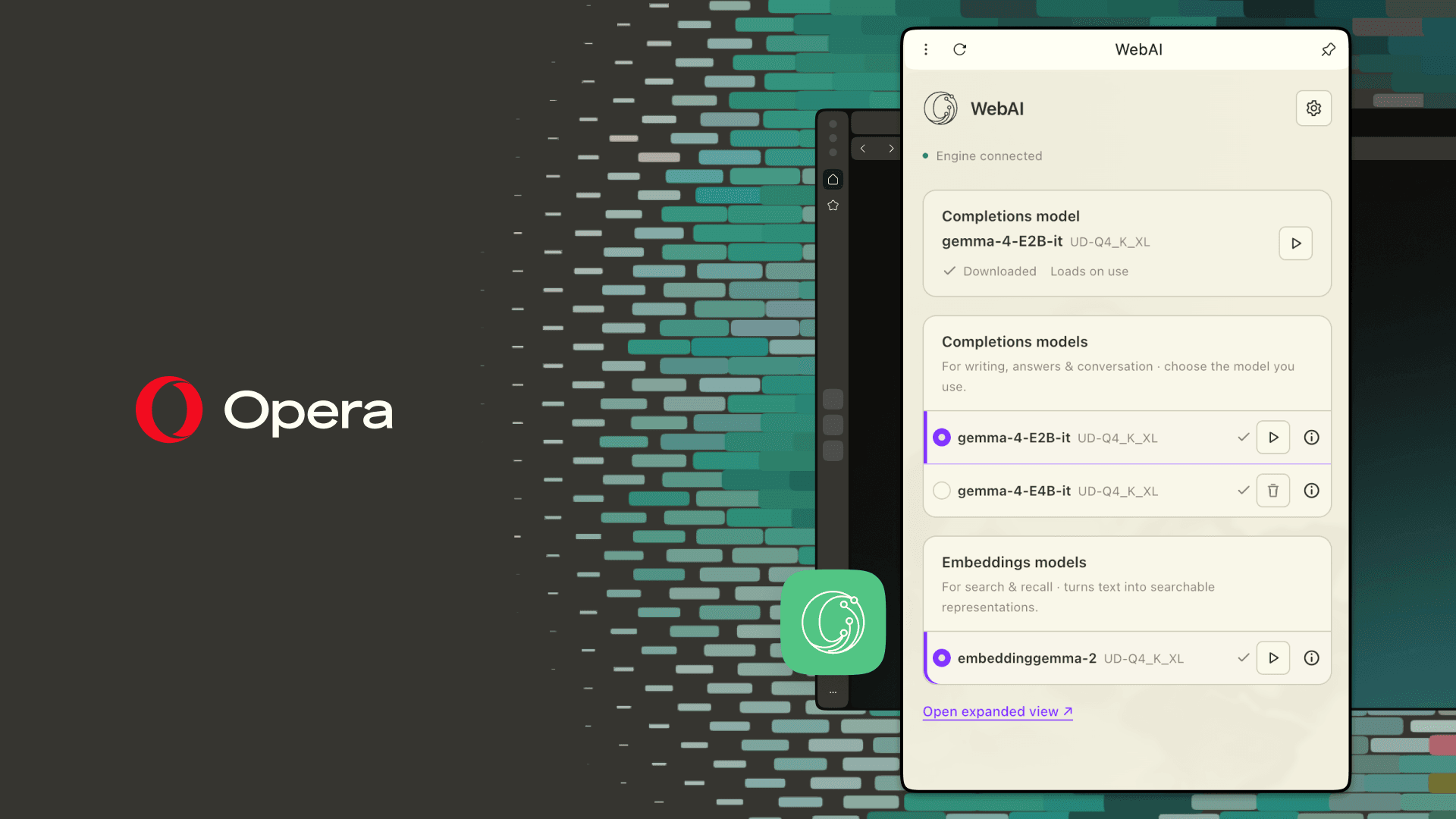
On 27 October, Opera began shipping local AI models in its browsers, starting with an early preview in Opera One. Users can run Apple’s on-device foundation model on Macs with Apple silicon, alongside Google’s Gemma, Opera said in its announcement. The preview relies on WebAI, a proposed web standard backed by companies such as Google and Microsoft, which lets websites and browser extensions use AI hosted through the browser.
The feature is opt-in: nothing is downloaded until the user turns it on, and site-specific permissions let users decide which websites can access local AI. Opera says WebAI can generate text, classify content and work out how pieces of information relate. The company also released example extensions to help developers experiment, including one that turns an article into moving art. 9to5Mac also covered the Apple angle.
Because the models run on the device, the information they handle stays on the machine, and developers do not pay per request. Opera says this lets them build on open-weight models without running AI infrastructure. The preview is available on 64-bit Windows PCs (Intel or AMD) and Macs with Apple silicon, and performance depends on the hardware. Opera GX and Opera Neon will follow; Opera has not given a date.
Separately, Opera introduced HTML-in-Canvas, which lets developers place working web pages inside 2D or 3D scenes. “You can take a real web page and throw it into a 3D world, and everything still works: buttons, text, menus, all of it,” said Maciej Kocemba, Product Director at Opera GX. Two demos, Webpage Bulldozer and Gamer Room, work in Opera browsers without additional setup.