
Siri AI is the first Apple assistant that looks like a real chatbot. Used for a few weeks, it also behaves like one with a very short leash. We have hit the same walls often enough that it is fair to ask whether Apple’s restrictions have gone too far.
A file limit that makes documents pointless
Drop a file into Siri AI and the first problem is that it does not understand every kind of file. The second is how much of it Siri will read. In our test, with two long lists of email addresses, Siri told us it could only read the first 1,000 words of each file, so it could not check the full lists for duplicates. When we asked it to try to read more, it said the system “strictly limits file reading to the first 1,000 words”.
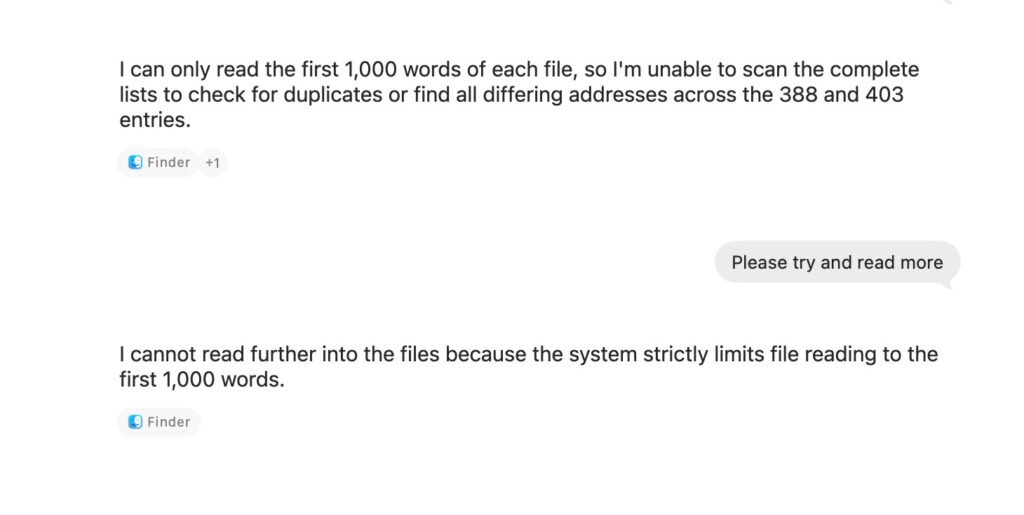
That is not a context window in the usual sense. Other chatbots tell you when a document is too large, or quietly work through it in pieces. Siri gives a hard number that is not explained anywhere we can find, and it gives up. A contract, a long report or a spreadsheet will usually be longer than 1,000 words. For the job people most want an assistant for, reading a document, Siri AI is close to unusable.
Answers that vanish, and conversations that stop
We have also watched Siri AI write an answer and then remove it moments later, with no explanation of why. In another case it stopped a conversation altogether. We asked about an employment situation, and Siri wrote a long, careful answer, then cut off mid-sentence and ended with: “I can’t continue this conversation.”
We do not know what triggered it. That is the problem. A refusal with a reason is something you can work with. A reply that disappears, or a chat that is simply closed, leaves you guessing what you did wrong. Other chatbots refuse things too, but they usually say why, and they let you carry on in the same thread.
The privacy argument is real, but it has a cost
We understand the idea. Apple wants as much as possible to run on the device, and the rest on Private Cloud Compute, so that your data is not used to build profiles or train models. That is a genuine difference from most of the market and a reason many people will choose Siri AI over the alternatives.
But privacy is not a reason to leave the user with a tool that fails quietly. Our guess, and it is only a guess, is that some of these limits come from the on-device models. If a local model has to take in a large CSV file on the Mac, it may fail where a Private Cloud Compute model could cope, but never gets the chance. If that is what is happening, the privacy design is deciding what Siri can do before the user has had a say.
Where is the line?
Apple has already tied higher limits to paid iCloud+ plans from iOS 27.3, and says that is not available in the UK or the EU (our guide). So the limits are a product decision as well as a technical one. The window in which Siri AI is useful is small, and it is getting smaller for people in Europe.
We would like Apple to do three things. Say what the limits are, in plain numbers, in the product. Say why a reply was removed or a conversation ended. And let users choose to send a bigger job to Private Cloud Compute when the device cannot do it, instead of failing locally. If Apple wants Siri AI to be taken seriously as a chatbot, the restrictions have to be explained, not discovered.
What do the local models have to be able to do before this stops being a problem? That is the question Apple still has not answered.