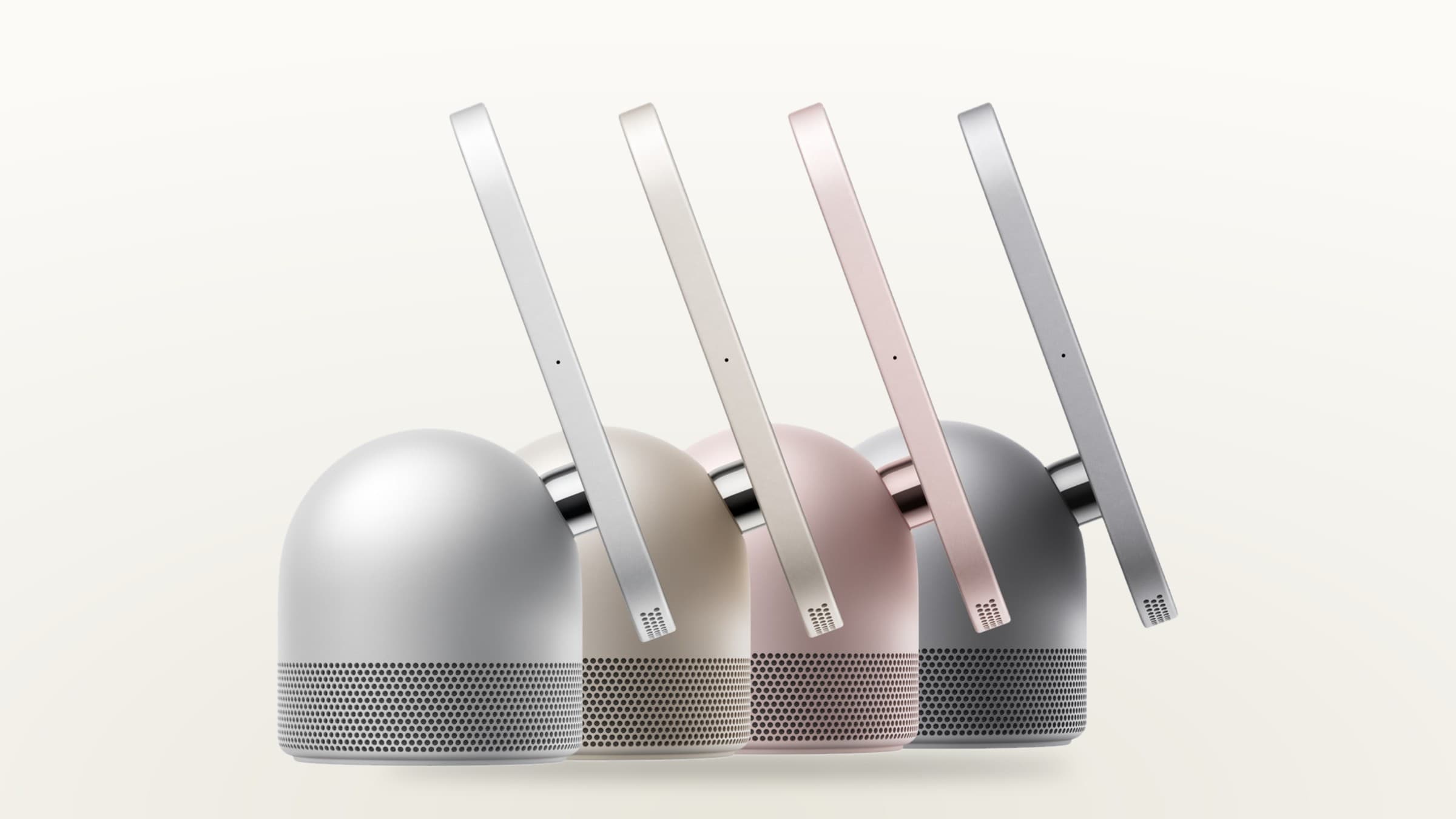
Apple today announced HomeView, a smart home display with a 7-inch screen, Siri AI and face recognition for up to six people, priced at £299 in the UK and $299 in the US. Pre-orders open today in six countries, with availability from 13 November, but HomeView will not be sold anywhere in the EU.
The tabletop model pairs an aluminium 7-inch Liquid Retina display with a domed speaker base, joined by a stainless steel hinge that tilts the screen. It comes in silver, starlight, rose pink and space grey, each with a matching USB-C cable. Brightness runs from 500 nits down to 0.3 nits for a bedside table, and the interface shows simpler information from across the room and more detail as you step closer.
A separate wall-mounted HomeView, in space grey and silver, has the same screen and features and the same price. It fits one of three mounts from Schneider Home: the Power Mount USB-C Wall Connector from $59.95 and the Power Mount AC Wired from $79.95 can be ordered today in the US, while the Power Mount PoE Wired follows in early 2027 at $129.95.
Personal for each user
HomeView recognises up to six people by their faces, and each gets their own Home Screen with apps and widgets. Personal content in Messages, FaceTime, Calendar, Reminders and Find My stays private to its owner, while shared photo albums and music are open to the whole household and guests.
Siri AI, Apple’s new version of Siri, is built in. With an Apple Intelligence-enabled iPhone or iPad, it can draw on a user’s personal context and act across apps; without one, users still get its world knowledge, natural conversation and improved music discovery. Conversations started on HomeView continue in the Siri app on other Apple devices. Requests use on-device processing or Private Cloud Compute, and Apple says the A18 chip’s Secure Exclaves process camera and microphone data separately from the rest of the system.
Home control, sound and FaceTime
By touch or voice, HomeView shows camera feeds and controls thermostats, lights, locks and blinds. It works with the new Apple Home Collection of cameras, thermostats and a lock made with LG Electronics and Schneider Electric, as well as other Works with Apple Home and Matter accessories. With a supported iCloud+ plan and compatible cameras, it can recognise people, familiar faces, pets, packages and vehicles with end-to-end encryption.
The base holds a down-firing woofer and two force-cancelling passive radiators, and HomeView joins HomePod speakers for multiroom audio and Intercom. FaceTime uses Center Stage to keep people in frame as they move around the room.
Prices and where you can buy it
According to Apple’s regional press releases, HomeView costs £299 in the UK, $299 in the US, C$429 in Canada, A$449 in Australia, NZ$599 in New Zealand and ₹39,900 in India, and the wall-mounted model costs the same in each market. The UK, Australian and New Zealand prices include VAT or GST, while the US price excludes sales tax. Apple has not yet published a Singapore price.
Pre-orders are open today in Australia, Canada, India, New Zealand, the UK and the US, and open in Singapore on 15 October at 9 am local time. Both models arrive on 13 November, with South Africa served through Apple Authorised Resellers. At launch, Siri AI on HomeView works in English only.
No HomeView for the EU
HomeView will not be sold in any EU country, because Siri AI is currently unavailable in iOS there. Apple says it is “working constructively with the EU in an attempt to find a path forward”, but gives no timeline. That leaves buyers in Ireland, France or Germany without the device, while customers in the UK get it on day one.
No keynote after all
After Greg Joswiak’s “Welcome home. October 13.” teaser, which we covered last week, some expected a full Apple event today. There wasn’t one: Apple held no streamed keynote and instead posted HomeView, a new Apple TV 4K, the HomePod mini 2 and the Apple Home Collection as four press releases shortly before 2 pm UK time.
Why it matters
HomeView is Apple’s first new home device category since the original HomePod, and the first Apple product designed around Siri AI from day one. In our view, it is also a test of whether a face-recognising screen in the kitchen can win trust, and the EU exclusion means European buyers will have to wait for Apple and Brussels to settle the Siri AI question.