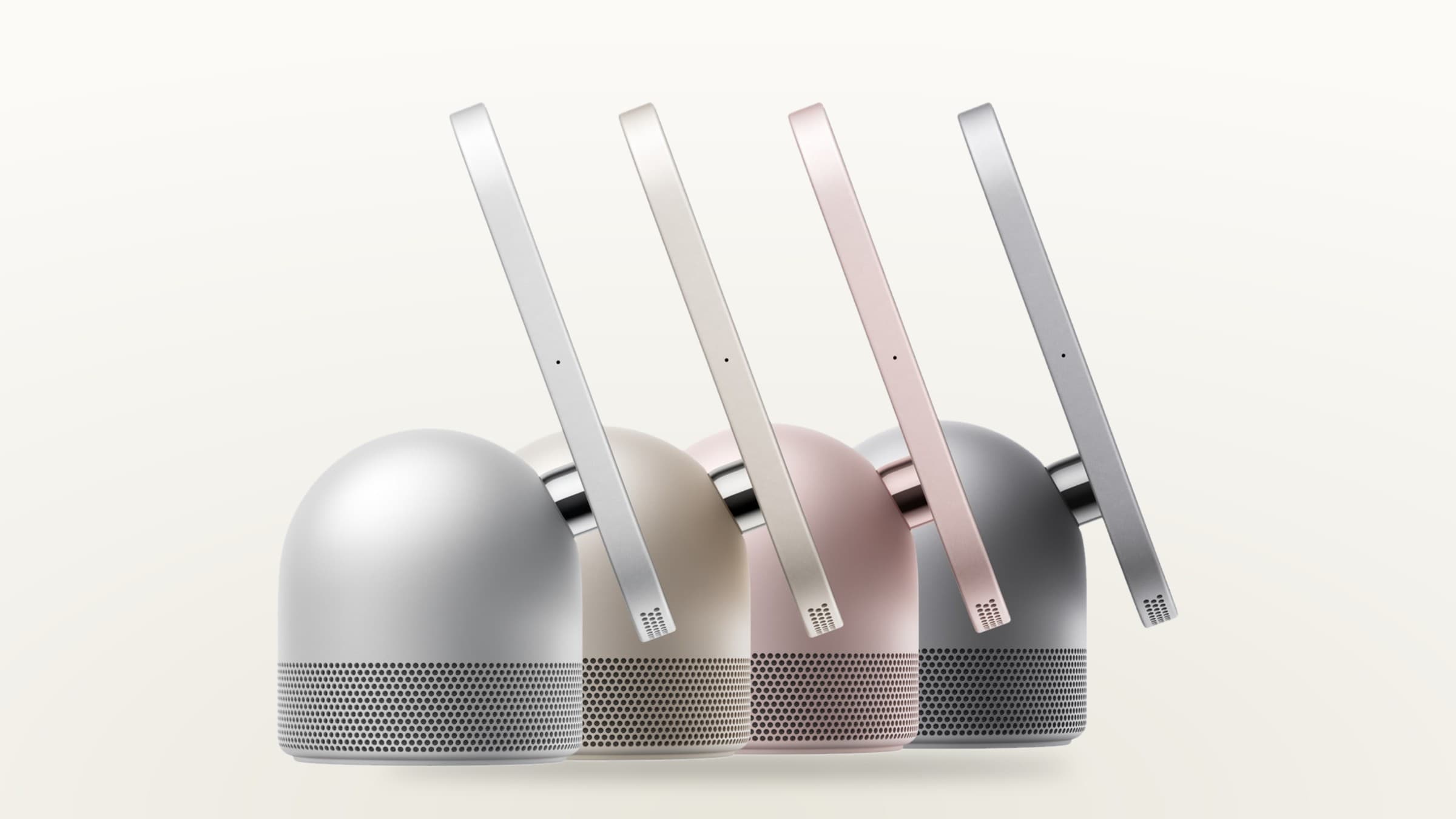
Apple finally has a smart home display. On 13 October it announced HomeView, the HomePod mini 2, a fourth-generation Apple TV 4K and its own Apple Home Collection of cameras, locks and thermostats, all on one day. It should have felt like the moment Apple took the home seriously. Instead, it feels like a launch assembled around a delay.
There was no keynote, just four press releases. And read side by side, those press releases describe a product line that does not quite agree with itself.
A screen that knows your face, but not like your iPhone does
HomeView recognises up to six people by their faces and gives each of them their own Home Screen. That sounds like Face ID, but it isn’t. Apple’s technical specifications list a 12MP Center Stage camera for FaceTime, not a TrueDepth system, and Apple’s announcement says personal content in apps like Messages and Calendar only appears when the enrolled user is recognised and their paired iPhone or iPad is present and has been recently unlocked. In other words, the iPhone in your pocket is doing the real security work.
That may be a sensible privacy trade-off. But it also means HomeView cannot vouch for you on its own, which is an odd position for a device meant to sit on a kitchen worktop all day.
The speaker will know your voice, the screen does not
The contradiction gets stranger next to the speaker announced alongside it. Apple says HomePod mini 2 will recognise up to six users by voice once Siri AI arrives, something HomePod speakers have done for years. Apple lists no voice recognition for HomeView, which identifies people with its camera instead. So the cheaper speaker tells family members apart by the way they talk, while the £299 display has to see you first. In a kitchen where someone calls out a request from the hob with their back turned, that is not a small detail.
A mini update, and silence for the big HomePod
HomePod mini 2 gets an S10 chip, new colours and four-speaker surround sound with the new Apple TV 4K. The full-size HomePod got nothing. Apple’s UK store still sells it at £349, with no new chip and no word on when it gets Siri AI. If HomeView and Siri AI are the future of Apple’s home, the speaker at the top of the range has been left out of the story.
And the mini itself ships without the feature that justifies it. Siri AI on HomePod mini 2 will come in a future software update, Apple says, with no date. Buyers who pick one up on 30 October get a better-sounding speaker running the old Siri.
Big bezels on a 7-inch screen
Then there is the hardware. HomeView’s 7-inch, 1088 x 1088 display sits inside a thick black border in Apple’s own product images. Yanko Design defends it as a taste call that gives the Photos face a picture-frame border. Next to a current iPhone or iPad, though, it looks like a design that was settled some time ago and never revisited.
The product that waited for Siri
That is probably because it was. Bloomberg reported in March, as summarised by MacRumors, that Apple first planned to launch its home hub in spring 2025, then moved it to spring 2026 and then to the autumn, each time because the new Siri was not ready. The hardware was said to have been finished for months.
You can feel that history in the launch. Siri AI on HomeView is still labelled beta in HomeView software 27.2. It needs iOS 27.2 on your iPhone, which was still in developer beta when pre-orders opened, and it works in English only. The EU does not get HomeView at all, because Siri AI is unavailable there. Some Home Collection accessories and the PoE wall mount slip to early 2027.
Made for America first, again
For readers outside the US, that pattern is becoming tiresome. Siri AI speaks English only at launch. The EU gets no HomeView at all. Professional installation through ADT is a US-only offer. Again and again, Apple’s newest features arrive in America first and reach everyone else later, in a reduced form, or not at all, while British and European buyers pay similar or higher prices.
Language is the sharper problem. Siri still works in the single language you pick in Settings. A household that speaks Danish and English, or Hindi and English, cannot ask a question in one language and follow up in the other, and a family device for six people is exactly where that matters. ChatGPT’s voice mode, by contrast, can switch languages mid-conversation and hold a natural, interruptible back-and-forth.
That is my real worry. While Apple spent years getting Siri AI ready for one language in one market, the benchmark moved. If Apple’s home assistant finally arrives as the Siri it should have shipped in 2024, it may already feel a generation behind what people use on their phones every day.
The counter-argument
To be fair, Apple was right not to ship a smart display with the old Siri. A home screen running yesterday’s assistant would have been worse than waiting. HomeView’s privacy design, with Secure Exclaves handling camera and microphone data and no ads on screen, is also a genuine contrast with Amazon’s Echo Show.
But waiting should have bought polish. Instead, Apple waited for one piece of software and shipped everything else as it was: a screen with dated-looking bezels, a speaker without its headline feature, a flagship HomePod left untouched and a face-recognising display that leans on your phone.
Why it matters
Apple rarely gets a second first impression in a new category. HomeView may grow into a good product as Siri AI matures, but this launch suggests Apple’s home strategy is still being set by its software timetable and its home market rather than by what households around the world actually need. The next update should close the gaps, starting with more languages, multilingual Siri and the big HomePod.