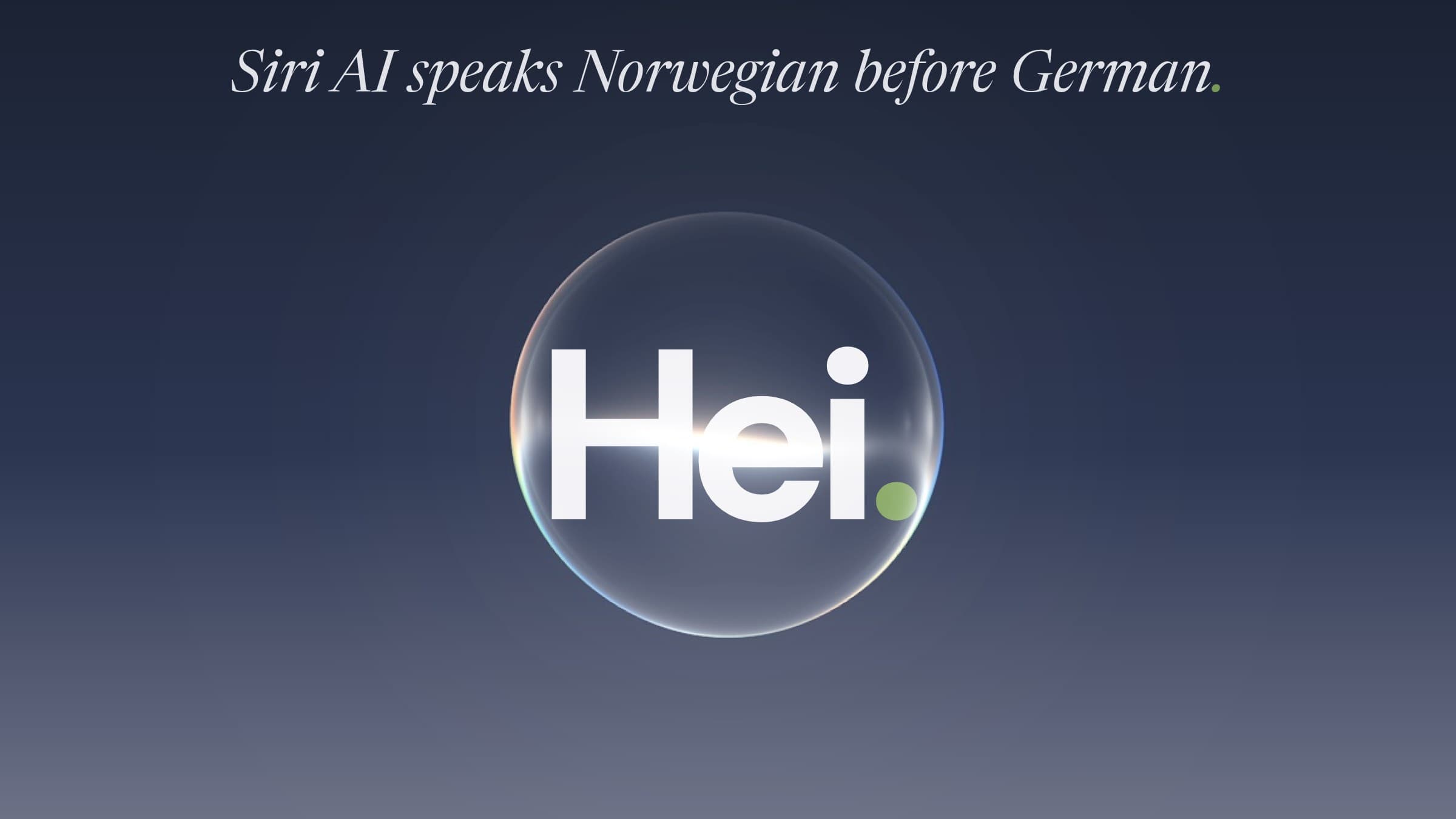
Siri AI now works in six languages, and Apple says Norwegian is one of the next four. German, Italian, Dutch, Danish and Swedish are not on the list, even though all five already work with Apple Intelligence. Apple hasn’t explained the order. Our reading is that the EU, not the size of the language, decides who goes first.
Here is what Apple has confirmed, why Norwegian, spoken by about 5 million people, is ahead of German, spoken by close to 100 million in Europe, and what you can do if you switch between two languages every day.
Apple Intelligence and Siri AI are not the same list
This is where most of the confusion starts. Apple’s own notes say Apple Intelligence works with Siri and device language set to 16 languages: Chinese (simplified and traditional), Danish, Dutch, English, French, German, Italian, Japanese, Korean, Norwegian, Portuguese, Spanish, Swedish, Turkish and Vietnamese.
Siri AI, the new conversational Siri, is a much shorter list. It needs an Apple Intelligence-enabled device “set to a supported language”, and today that means English, French, Japanese, Korean, Portuguese or Spanish. So a German speaker can use Apple Intelligence features such as Writing Tools in German, but gets the older Siri.
Why Norwegian comes before German
Apple doesn’t say. But the pattern in its announcement is hard to miss. Every language with a date sits mainly outside the EU: Norwegian in Norway, Turkish in Turkey, Vietnamese in Vietnam and traditional Chinese in Taiwan and Hong Kong. The six languages without a date are spoken mainly inside the EU (German, Italian, Dutch, Danish, Swedish) or in mainland China, where Apple Intelligence has its own regulatory hurdles.
Apple says Siri AI is “currently unavailable in the EU in iOS, iPadOS, and watchOS” and that it is “working constructively with the EU in an attempt to find a path forward”. Norway is in the European Economic Area but not the EU, and the Digital Markets Act, which Apple has blamed for earlier EU delays, doesn’t apply there. A Norwegian Siri AI can ship on iPhone. A Danish or German one would, for now, only work on a Mac.
This is our assessment, not Apple’s explanation. It doesn’t fully explain German: Switzerland and Liechtenstein are outside the EU too. But Germany and Austria are by far the largest German-speaking iPhone markets, and they are in the EU. The same goes for Italian and Dutch. French, Spanish and Portuguese escaped because of Canada, Switzerland, Latin America and Brazil, even though iPhone owners in France, Spain and Portugal still can’t use them.
When could Siri AI reach the EU?
Apple hasn’t given a date. There is a precedent: Apple Intelligence was held back in the EU in 2024 and arrived with iOS 18.4 in April 2025. If Siri AI follows a similar path, spring 2027 is the earliest realistic window. Features such as iPhone Mirroring are still missing in the EU, so it could take longer.
Expect German, Italian, Dutch, Danish and Swedish to follow only once the EU question is settled, because there would be little point in launching them while most of their speakers can’t turn Siri AI on.
Can Siri AI speak two languages?
No. Apple hasn’t announced bilingual or multilingual Siri AI, and there’s no mention of it in the 27.2 release. Siri AI follows your Siri and device language, so you can’t mix English and French in one conversation.
What you can do today:
- Set Siri and your device to a supported language, for example English, to get Siri AI. Your keyboard can still include Danish, German or any other language for typing.
- Change Siri’s language when you need to in Settings, under Siri. Siri AI then needs that language to be one of the six supported ones.
- On a Mac in the EU, Siri AI is available, but only in a supported language.
Why it matters
For millions of people in Europe who use English as a second language, Siri AI forces a choice: switch the whole device to English, or wait. Language support, not hardware, is now the main thing deciding who gets the new Siri, and in Europe it is tangled up with regulation.
Read the news story on the five new Siri AI languages, Apple’s new daily usage limits, and our Siri AI guide for supported devices and countries.